On Paths Elsewhere
July 2026, Vienna

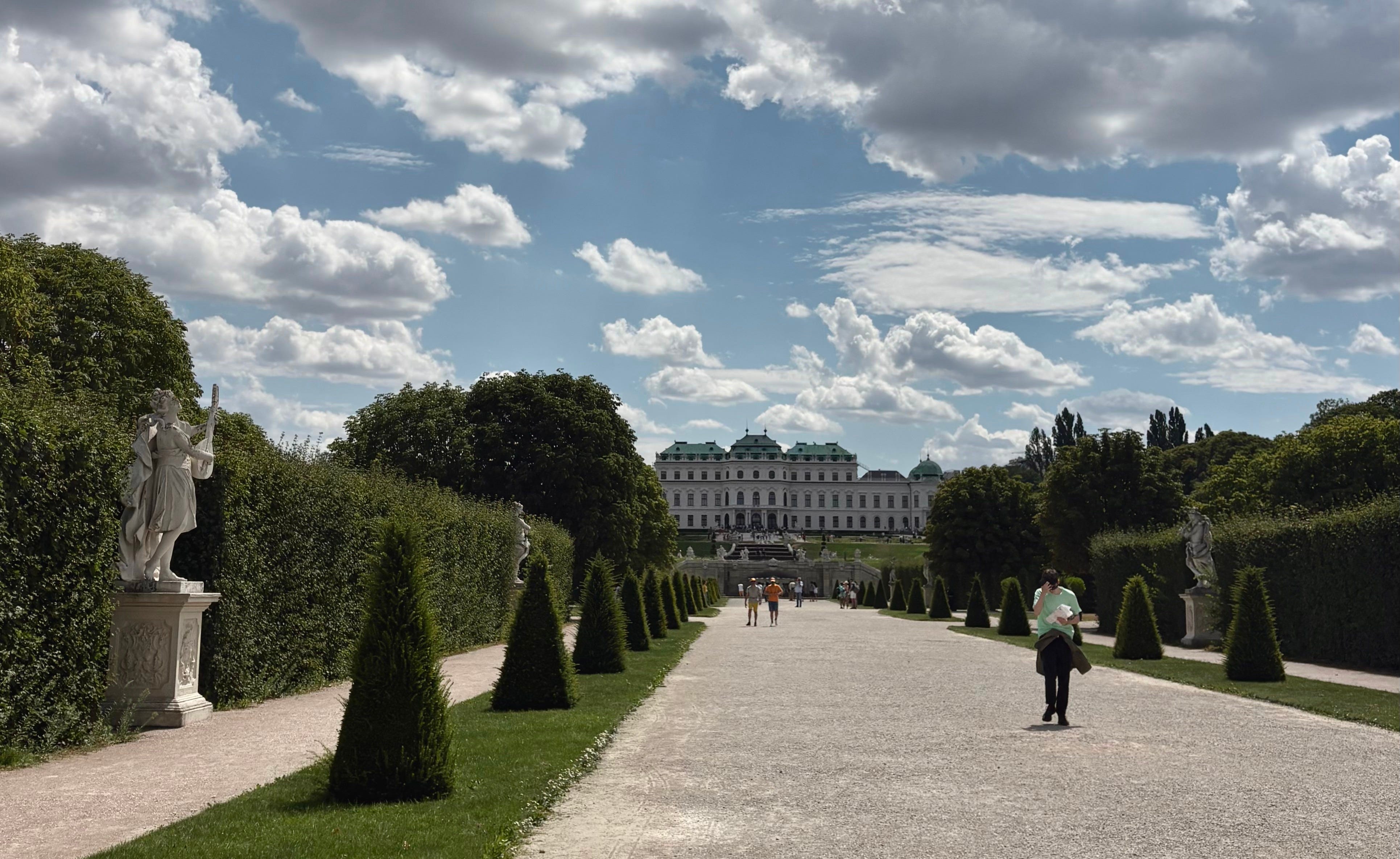
A brief trip to Vienna, made painless by my shiny European visa. World Cup final weekend spent in one of the best cities to live in the world, Reportedly. Grand statues, gleaming facades, manicured gardens. Like many Western European cities, Vienna is reluctant to remove the costume and unveil itself to you. Cities like San Cristobal, Mumbai, New York, Wrocław, Brno flow and you step into their unfamiliar currents to figure out where you are. But Vienna, by contrast, centers around a spectacle of time-gone-by and hides its lifeblood. Bobbing and bouncing flags of militant tour groups. Hawkers and cheap-expensive goods. Clattering sound of horse-drawn carts. English the lingua franca of commerce. The strange sense of familiarity in a new locale.
But leave behind the granite and limestone architectural marvels of the Ringstraße, and there’s a continuity flowing deeper than Sachertorte and brocade wallpaper. Young fathers in suits with their children in Sunday cafes, the ironic intimacy of Wiener Schmäh culture. An old woman is baptized outside a small church next to her Skoda, the faint screams from the amusement park become part of the priest’s chant. A man in a ruff collar and exaggerated green eyebrows leads a group of forty strangers in pantomiming “Habanera” from Carmen. Techno and cargo pants at the pastel-colored Wurst stands. Old World pageantry and contemporary creation.
On my second day, I take a red tram up to Quartier Belvedere and find the intentionality and order of the Baroque gardens connecting the Upper and Lower Palace buildings. So Apollonian in its design that it is impossible to wander or to get lost amongst the hedges and marble forms; the paths were set for you centuries ago and even the tourists seem to mill in single file.
Beneath a manicured maple, I sit and turn my thoughts inward to new dark woods.
Toward how foreign cities can serve as emblems before the tourist sets foot on strange soil. Backdrops for projections as the dreamer escapes their situation to envision another self in a utopian Paris/New York/Vienna/Tokyo. To self-soothe in a place that must polish rough edges. The citizens of those fantastical cities somehow imbued with secret knowledge of how to live.
In my five years living in Manhattan, I saw it in the glossy eyes of tourists shuffling toward the imposing Empire State Building. The reverential gaze when in slacks and a silk button-down shirt I’d stride past the Midtown crowds to my towering office.
My fantasy was Vienna. Countless late nights as I out-walked out-biked out-ran myself. The length of Manhattan was an exercise interval as I’d cannibalize myself and dream of the Vienna of Billy Joel, how someday I’d be worthy. I’d fantasize and rehearse the romantic elation of meeting someone perceptive enough to find me as we would drift together through the Vienna of Before Sunrise. The idealized peace of the Other, of emancipating myself enough to find salvation.
I didn’t dream of the Innere Stadt or the powdered wigs of Wolfgang. I did not know the names of St. Stephen’s Cathedral or even the Danube. What I had was the Vienna formed in the mind of a little girl who ate peanut-butter-and-jelly toast for breakfast and stared out the window to watch the mule deer in her backyard. In childhood I had the reliability of near-constant solitude; wandering woods alone, book-reading interspersed with rare socializing. Most of my early memories consist of the products of my own imagination.
And so I, the adult woman, am here. Somewhere in-between expectation and reality. A wraith and a woman. There are people waiting for me in a city nearby, home is still a blurry concept. The knots and bindings are loose. But I am not alone and no longer a stranger in a strange land. A friend to eat with at the end of the day, a partner to call. The benevolent feeling of being a guest in a foreign city allowed to shed the mess of daily struggle.
So what happens when the dream tourist gets to New York/Paris/Vienna? Ideal stoops to meet real. Perhaps a mild “Paris Syndrome”, when a smattering of Japanese tourists suffered psychological breaks in the 1980s as their utopian vision of Paris clashed with the mess of the true city. Perhaps the dream endures. Perhaps something in you resolves. Perhaps not.
So I came to make meaning in seeing Klimt’s masterpieces at the Belvedere. His gold leaf, the Sacred in the erotic and sensual, something exalted but raw. I wanted to see The Kiss. To look at the physical surrender of the woman, the complete envelopment and blurring of boundaries between lovers. I thought it would reveal something in me, give me an answer. Vienna, Vienna.
In Berlin I recently attended a symposium in a contemporary artist’s studio. In a circle of eccentric attendees, we dried our mouths on conversation and semi-stale Lidl cookies. Carefully worded questions and a thick smell of paint in the cool of his concrete studio.
In the circle of folding chairs, I had asked the artist whether he has an emotional intention for the viewers of his art. He seemed mildly baffled by my question before sharing he had not considered the emotional reception. He spoke of Kant, of spirituality, of trying to transfigure something metaphysical and impossible to translate to his canvas. Once the creative process is complete, so is his work. His task to serve as a conduit was first, the legacy and impact of the paintings secondary.
I think of art as a relationship among three primary nodes: artist, work, viewer. I fixate on the relationship between second and third node, what exists between the art piece and the viewer. How the same physical object changes under the scrutinies, passing glances, emotional pangs, apathies of viewers. How this differs from the artist’s intention, especially as time shifts and wears down the original context of cultural norms, language, expectation.
At the high-ceilinged Belvedere, Klimt’s intention and the composition of The Kiss was to be secondary to me. I wanted the work itself. To see what would exist between us. I had to be alone to do it.
When my two-hour ticketed wait time expires, I ascend the chandeliered staircase to step into the room. I gently shoulder my way to the back of the thick semi-circle of chattering people venerating The Kiss. Over the tops of heads I see the piece and feel the thrill of simply being there fade. The anticipatory catch in my chest releases.
There is nothing in the in-between. For me and The Kiss, nothing passes between us. It is beautiful, it is commanding, I feel nothing, I think nothing.
I am but a partial portion of a jostling spiraling crowd.
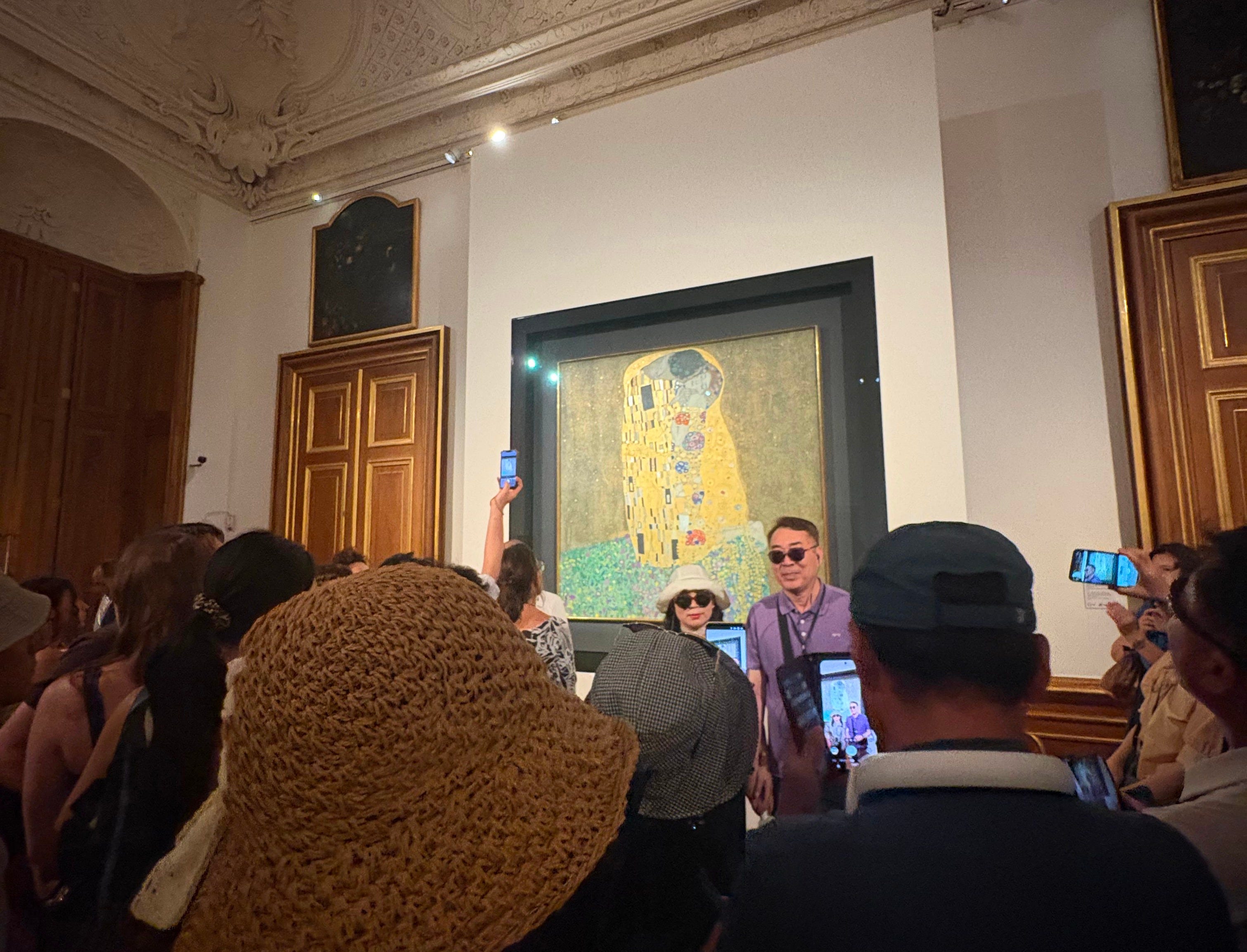
Anticlimax as a wife pulls her husband with a buzzing handheld fan through a troupe of young Germans. Another couple poses, kisses beneath Klimt. It is a chaste kiss, perfunctory. Devoid of any surrender to the charged desire behind them. Electricity does not conduct well through wood, I think.
I have become a sociologist, watching the quasi-religious as phones with hands attached bump and weave to the front to capture the icon. I move through the throng, also get my chance. But when I am before the painting I too take out my phone to externalize my memories and prove that yes, I, was there.
I slink backward through the crowds and pad into the next room, eyes brushing over figure after figure. I feel distanced empathy for Paris Syndrome. My question feels unanswered still, but it begins to fade. I lightly trace the room. My gaze is pulled back left. It’s Klimt again, his Judith, and I involuntarily step left. So something is called into being between the paneled painting and me.
I look Klimt’s Judith in the face, and Artemisia Gentileschi’s 1620 version shoulders into my mind. Gentileschi’s Judith is violent, arresting. It is a brutal takeback of power, a proposed literal canvas for Gentileschi as Judith, and her rapist, Agostino Tassi as Holofernes. At age 18 she had stood as witness against Tassi, undergoing torture on the stand to prove her testimony. The year was 1612. Caravaggio’s Judith seems limp in comparison.
I cannot separate Gentileschi’s story and the tale, and so to me, Judith is a woman avenging herself. This thought flits by as I’m rooted by a painting previously untouched by my imagination.
So there rests Klimt’s Judith, with her erotic challenge. She is a complete person, she looks the viewer in the face, head tilted and the vulnerability of her neck exposed. Her eyes half-closed, mouth half-open, Body language languid. The brutality of Holofernes an anecdote, his head almost out of frame.
There are so many strangers next to me. I overdue the unspoken polite standing time in front of Judith and the crowd thickens, encloses.
I begin to cry. I stand alone.
I finish winding through the opulent rooms and the remainder of the works stack beneath Judith. A modern piece that has filled the room with the heady smell of lavender stalks. Sculptures and medieval icons and Modernists grappling with the aftermath of the Second World War. They slide off me like water and there is nothing but space between us.
I take the tram back to the city center. It is punctual, does not leave the route. My hand wound around the yellow trolley pole, my shoulders relax. I look straight ahead. I am on paths elsewhere.
♥️♥️♥️